|
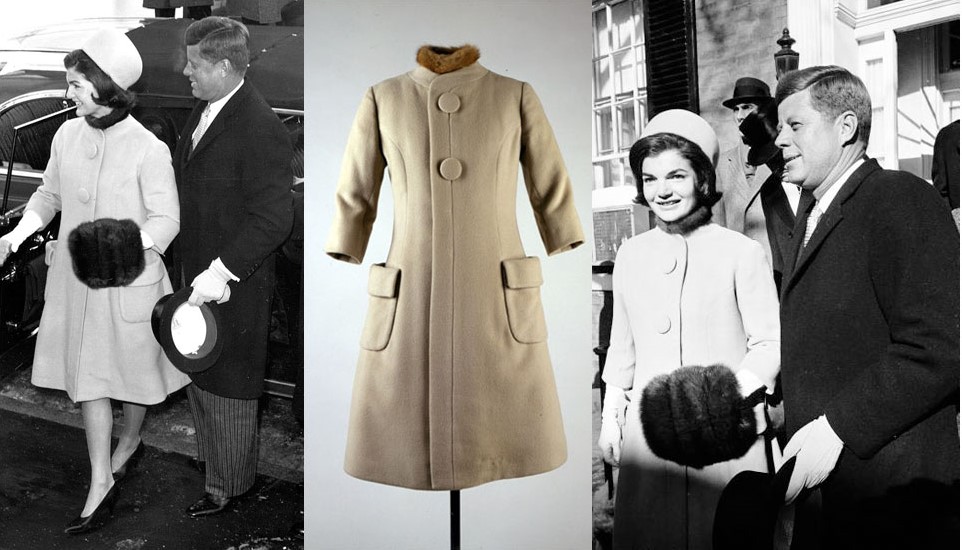
On January 20, 1961, John Fitzgerald Kennedy took the oath of office to become the nation's 35th president and at age 31, Jacqueline Kennedy became the first lady.
Shortly thereafter, Jackie began a major renovation of the White House. She wanted to make it into a real home for her family. She turned the sun porch on the third floor into a kindergarten school for Caroline and 12 to 15 other children, and added a swimming pool, a swing set, and a tree house on the White House lawn for Caroline and John Jr.
 |
| Photo taken in early 1962 during a televised tour of the White House |
Her legacy of fostering a national interest in historic preservation extended to her own "neighborhood," when she reversed a previous federal plan to destroy the historic Lafayette Square across from the White House and helped to negotiate not only a restoration of old buildings there, but a reasonable construction of new buildings with modern use.
Jackie used the White House to "showcase" the arts. She became the most prominent proponent for the establishment of the National Cultural Center in the nation's capital, and eventually it was named for her husband. She hosted performances of opera, ballet, Shakespeare and modern jazz, all performed by American companies. After her meeting with French Minister of Culture, Andre Malraux in May of 1961, she dazzled him so much that he made a loan to the U.S. from France, of the Louvre Museum's famous Mona Lisa painting, in which she presided over the unveiling.
Jackie traveled with the President, representing the US abroad. On a trip to Paris, as the President went from meeting to meeting, she maintained a schedule of her own events. Already admired for her style and beauty, she bedazzled the public with her knowledge and affinity for the French language, culture, and history. She was a particular sensation, and the President delighted in her success. During a speech, the President introduced himself as, “I am the man who accompanied Jacqueline Kennedy to Paris, and I have enjoyed it.”
As first lady, Jackie also traveled to many foreign countries such as Italy, India, and Pakistan. Her interest in other cultures and her ability to speak several foreign languages, including French, Spanish, and Italian, brought her good will and admiration around the world. And, on many of these trips, she forged personal friendship with world leaders, which helped to further the interests of the President and the U.S.
Jackie had an intense interest in the issues faced by the Administration and privately she was known to provide the President with her assessments of the political figures with whom he was negotiating. She, also, subtly showed support of the Civil Rights movement by ensuring the kindergarten at the White House was racially integrated and that photographs of the group were publicly released.
 |
| JFK and Jackie arriving at Love Field, Dallas Photo Credit: LIFE Magazine |
While many of her outfits are considered iconic, it's the pink Chanel suit that she wore the day of her husband's assassination that remains in the forefront of the public's consciousness. Even as Lyndon Johnson took the oath of office, hours after the President's death, she refused to remove the suit, even though it was splattered with blood and brain matter, telling his wife Lady Bird Johnson, "I want them to see what they have done to Jack."
She planned the President's state funeral, it was broadcast around the world, and millions of people shared her grief and admired her courage and dignity. She has since been noted as saying, “I have been through a lot and have suffered a great deal. But I have had lots of happy moments, as well. Every moment one lives is different from the other. The good, the bad, hardship, the joy, the tragedy, love, and happiness are all interwoven into one single, indescribable whole that is called life. You cannot separate the good from the bad. And perhaps there is no need to do so, either.”
Stay tuned for part three, Jackie - After the White House.